

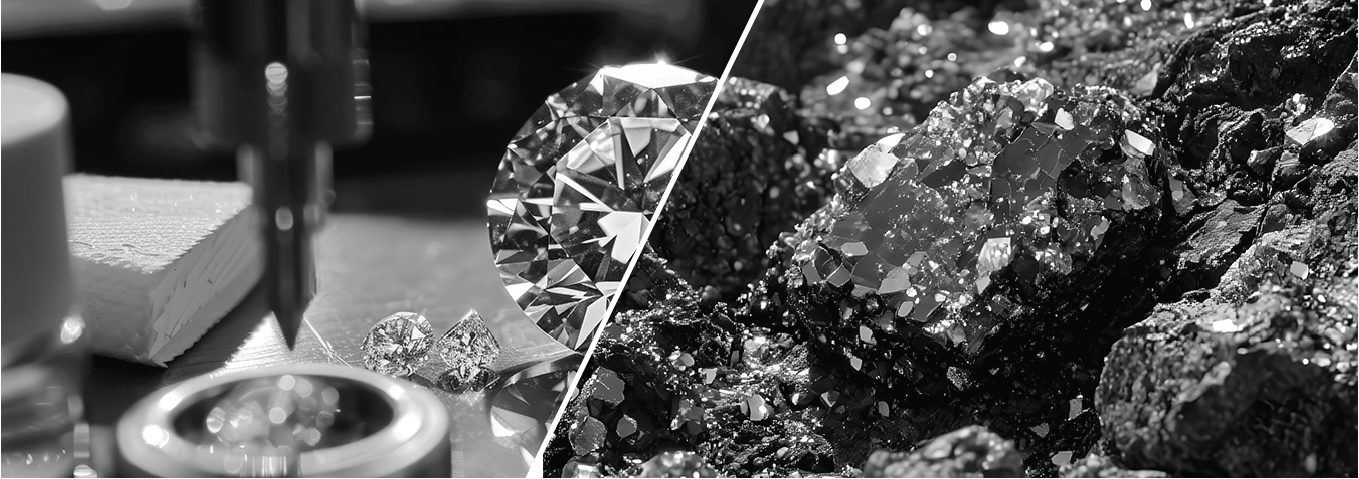
Lab Grown Diamond 4Cs: How to Choose the Best Stone
Lab grown and natural diamonds share the same chemical, physical, and optical properties, and both are graded against the same standardised criteria the industry has relied on for decades. The 4Cs (cut, colour, clarity, and carat weight) determine a diamond's beauty, rarity, and price, regardless of how the stone formed. Whether grown by CVD or HPHT in a controlled laboratory environment, a lab grown diamond is assessed against exactly the same benchmarks as an earth-mined stone. This guide explains which C to prioritise when buying a lab grown diamond, and how to balance all four to get the most brilliance for your budget.
• Cut: how well a diamond's facets interact with light for sparkle and fire
• Colour: body colour on the D-to-Z scale, from colourless to light yellow
• Clarity: the presence and visibility of inclusions and blemishes
• Carat weight: the measured weight of the stone, indicating size
Cut has more influence on a diamond's sparkle and brilliance than any of the other 4Cs. It measures how well a diamond's facets interact with light: specifically, how proportion, symmetry, and polish govern light return, fire, and scintillation. A well-cut diamond channels light back through the crown for maximum brightness; a poor cut lets light escape through the sides or base, leaving the stone comparatively dull. Because the effect is so visible to the naked eye, cut has an outsized influence on both a diamond's value and its everyday appearance.
Shape (round, oval, cushion, emerald, pear, marquise) describes a diamond's outline, not its cut grade, and the two are often confused. The round brilliant, with its 57 to 58 facets, remains the most optically efficient shape when properly proportioned.
• Common cut grades for round brilliants: Excellent, Very Good, Good, Fair, Poor
• For engagement rings and fine jewellery, prioritise Excellent or Very Good cut before stepping up colour or carat
• A 1.00 ct lab grown diamond with an Excellent cut can appear brighter and visually larger than a 1.20 ct stone with a mediocre cut; the difference is immediately visible
• Fancy shapes (oval, cushion, emerald) often lack formal cut grades but still depend on good crown angles, depth, and symmetry; ask jewellers for light-performance imagery
• On a lab report, check cut grade, polish, symmetry, depth percentage, and table percentage
Maitri applies precise cutting standards across its collection, ensuring every stone delivers the brilliance both retail and trade clients expect.
Diamond shape and cut grade are distinct. Shape affects perceived size at the same carat weight and influences how colour and clarity appear.
• Round: classic, most efficient with light; appears slightly smaller per carat than elongated shapes
• Oval and pear: look larger face-up; watch for bow-tie effects in poorly proportioned stones
• Cushion: carries weight in depth; softer silhouette
• Emerald and Asscher: step-cut facets reveal inclusions more easily; higher clarity recommended
• Princess and radiant: brilliant faceting hides inclusions well
Maitri offers calibrated polished lab grown diamonds in all major shapes for both retail jewellery and wholesale supply.
Colour grades run from D (colourless) to Z (light yellow). Stones in the D–F range are graded colourless, with the icy, bright appearance most buyers picture when they think of a top-grade diamond; G–H stones are near-colourless and still read as white face-up in the majority of settings. Lab grown production tends to achieve tighter colour consistency than mined stones at a comparable price point, which is why many Maitri stones fall in the D–H range.
• D–F: colourless; premium look, particularly striking in platinum or white gold
• G–H: near colourless; excellent value for most buyers; warmth barely visible to the unaided eye
• I–J: slight warmth; pairs well with yellow or rose gold, which can mask tint
• Fancy colours: lab grown pinks, blues, and yellows exist on a separate scale; more affordable than comparable natural fancy colours
Maitri's CVD process controls nitrogen impurities to achieve stable, high-grade colour. Any post-growth treatments are fully disclosed on grading reports, ensuring transparency.
Balancing Colour with Cut and Carat Weight
Because lab grown diamonds carry a gentler price curve between grades than natural stones, a small adjustment in colour can unlock real gains elsewhere. Stepping down from F to H colour, for instance, often frees enough budget to move up to an Excellent cut or a noticeably larger stone, a trade most buyers won't regret once the ring is on the finger.
Clarity measures the presence of inclusions and blemishes within a diamond. The GIA clarity scale runs from FL (flawless) to I3:
• FL / IF: no inclusions visible at 10× magnification; exceptionally rare
• VVS1 / VVS2: very, very slight inclusions; extremely difficult to detect
• VS1 / VS2: very slight inclusions; not visible without magnification
• SI1 / SI2: slight inclusions; may be visible to the unaided eye depending on shape
• I1 / I2 / I3: inclusions visible without magnification
Lab grown diamonds typically achieve higher average clarity grades than natural diamonds at a comparable price. GIA research comparing near-colourless stones of both origins has found lab grown CVD diamonds trending toward a median clarity of VVS2–VS1, against VS2–SI1 for natural stones in the same colour range.
• For brilliant cuts: VS2 or a well-positioned SI1 is generally eye-clean
• For step cuts like emerald or Asscher: aim for VS1 or higher; large open facets make characteristics more visible
• CVD-specific inclusions (growth remnants, planar clouds, internal graining) are accounted for in standard clarity grading
Choosing Clarity by Budget and Use Case
• Everyday solitaire: VS2–SI1, eye-clean beauty without overpaying
• Luxury statement piece: VVS2 or higher, minimal inclusions under any scrutiny
• Trade pavé or melee: SI1–SI2 calibrated stones, well matched and well cut for setting without visual compromise
Maitri offers sorting and batch services for wholesale clients needing consistent clarity across orders.
Carat weight measures a diamond's mass rather than its size; one carat equals 200 milligrams. How large a stone actually looks face-up depends on cut proportions and shape, not weight alone.
• A well-cut 0.90 ct round can measure nearly the same diameter as a 1.00 ct stone cut with excessive depth
• Lab grown diamonds make larger carat weights far more accessible; a budget that covers a 1.00 ct natural stone may reach 1.50–2.00 ct in lab grown
• Avoid sacrificing cut for carat; a large but poorly cut stone looks lifeless regardless of size
• Magic sizes (0.50, 1.00, 1.50, 2.00 ct) carry price premiums; choosing just under (0.90 ct, 1.40 ct) saves cost with almost identical visual presence
Carat Weight and Diamond Shape
• Cushion and princess shapes carry weight deep in the pavilion; face-up size may appear smaller than carat suggests
• Ovals and pears spread weight across their length, creating a larger visual footprint
• For solitaire settings: 1.00–1.25 ct centres suit most finger sizes; halo designs can make a 0.80 ct centre appear like a 1.20 ct stone
• Wholesale designers can optimise by pairing 1.00–1.25 ct centres with 0.01–0.03 ct pavé melee for balanced proportion and cost
The ideal combination of the 4Cs depends on your priorities, budget, and personal preferences. For most buyers, the best approach is to prioritise cut first, as it has the greatest influence on a diamond's sparkle and overall appearance. Once you've chosen an excellent cut, you can balance colour, clarity, and carat weight according to what matters most to you. Because lab grown diamonds generally have a gentler price curve than natural diamonds, buyers often have more flexibility to choose higher grades or a larger stone within the same budget.
Independent certification gives buyers an objective, third-party basis for their decision. Whether you choose a diamond graded by IGI or GIA, reviewing the grading report alongside expert guidance helps you compare stones with confidence and understand exactly what you're buying.
Ultimately, there is no single "perfect" combination of the 4Cs. The right choice is the one that best reflects your priorities, whether that's exceptional sparkle, a larger appearance, premium specifications, or the best overall value. By understanding how the 4Cs work together, you'll be well equipped to choose a lab grown diamond with confidence.
Explore Maitri's lab grown diamond collections to find the stone that matches your vision. Retail shoppers can browse our jewellery online, while trade partners are welcome to get in touch for calibrated, certified supply tailored to precise 4Cs requirements.