

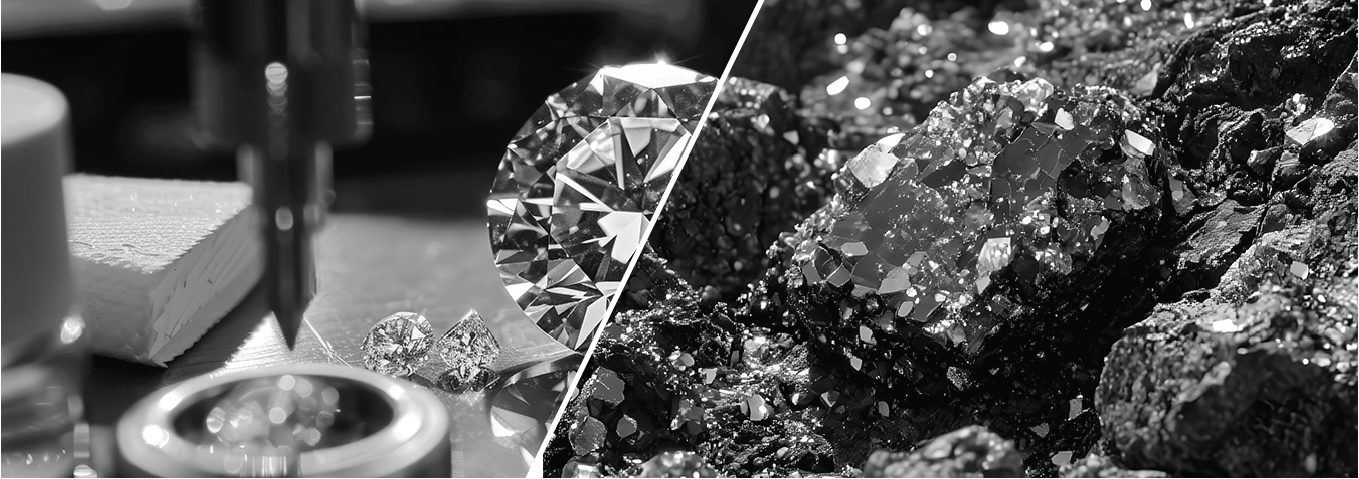
CVD Diamonds vs HPHT Diamonds: Understanding the Two Paths to Cultivation
Every lab grown diamond begins the same way: as pure carbon, drawn into a crystal structure through precision rather than time. CVD and HPHT remain the two primary methods used to cultivate diamonds in a laboratory, and the question of CVD diamonds vs HPHT diamonds surfaces early in almost any search for a lab created diamond.
Neither approach is an imitation of anything. Unlike a diamond simulant such as synthetic moissanite, a lab grown diamond, whether cultivated by CVD or HPHT, shares the same chemical composition, crystal structure, and physical properties as a natural diamond formed deep within the earth. This article sets out how each growth process works, where the two diverge, and what that distinction means in practice for anyone considering a lab diamond for an engagement ring or fine jewellery.
What Are CVD Diamonds? Understanding Chemical Vapour Deposition
What Are HPHT Diamonds? Understanding High Pressure High Temperature Growth
HPHT stands for high pressure, high temperature, or pressure high temperature (HPHT), a process that recreates the extremely high pressure and high temperature conditions found within the earth's mantle, where natural diamond formation takes place over billions of years, long before any diamond reaches the earth's surface. A small seed crystal is placed inside a growth cell with a high purity carbon source, usually graphite, and a metal flux of iron, nickel, or cobalt.
The assembly is placed within a substantial press, generating pressures of roughly 5 to 6 GPa and temperatures between 1,300°C and 1,600°C. Within this environment, the molten metal dissolves the carbon material, which then crystallises onto the seed as diamond, echoing in miniature the natural process that has formed diamonds since the earth's earliest history.
HPHT has supported industrial diamond production since the 1970s, with gem quality cultivation following in the 1990s. The engineering behind it has advanced considerably: the largest known laboratory grown rough diamond, verified in 2021, weighed 150.42 carats. It also remains a mainstay for much of the world's small diamond and melee production, alongside its long-standing role in producing fancy coloured stones.
Because HPHT cultivation involves molten metal, HPHT diamonds may retain minute metallic inclusions. When nitrogen is carefully managed, however, HPHT lab grown diamonds often emerge from the press with consistent colour already established, sometimes without need for further refinement.
It is worth noting that the same high pressure high temperature process is also used to enhance colour in certain natural stones, producing what is known as an HPHT treated natural diamond, a distinct product from a lab grown HPHT diamond, and one that should always be disclosed on a grading report.
CVD Diamonds vs HPHT Diamonds: How the Two Methods Compare
| CVD | HPHT | |
|---|---|---|
| Process | Carbon atoms deposit from a gas plasma onto a seed within a vacuum chamber | Carbon dissolves in molten metal under sustained pressure and heat |
| Typical crystal form | Flat, tabular growth | Octahedral or cubic forms |
| Common inclusions | Strain patterns, minute non diamond carbon traces | Metallic flux traces, colour zoning |
| As-cultivated colour | Occasionally requires post growth treatment to reach top colour grades | Often colourless or near-colourless as cultivated |
| Typical strength | Larger diamonds, above roughly one carat | Small diamond and melee production, plus fancy colours |
For anyone selecting a diamond, this distinction is one of process rather than outcome. Growth method may influence how a stone is refined or what a laboratory notes under magnification, but it has no bearing on whether the result is one of the real diamonds available to buyers today, nor on how that diamond performs once set.
Do CVD and HPHT Diamonds Look Different?
Durability, Hardness and Everyday Wear
Certification, Treated Diamonds and Traceability
CVD Diamonds vs HPHT Diamonds: Which Should You Choose?
The Bottom Line
Both CVD and HPHT diamonds measure a full 10 on the Mohs hardness scale and share identical thermal conductivity. Chemically and structurally, they are the same as any diamond produced through natural diamond formation within the earth. Growth method has no bearing on how a stone withstands daily wear.
What does affect durability is a stone's individual clarity characteristics, together with its cut and setting. A diamond with pronounced internal strain, regardless of origin, may be more prone to chipping at a sharp edge, such as a princess or marquise corner. The setting itself, whether prong, bezel, or channel, plays an equally significant role. Our complete guide to the 4Cs sets out how clarity and cut shape a diamond's long-term performance.
Recognised laboratories, including GIA and IGI, grade lab grown diamonds against the same 4Cs standard applied to a natural diamond, and record the growth method directly on the report, typically as "Laboratory Grown, CVD" or "Laboratory Grown, HPHT." Most reports include a laser inscription on the girdle, linking each stone to its certificate, with any treated diamonds disclosed in full, including post growth treatment for colour or clarity.
At Maitri, traceability extends beyond the certificate. Every diamond's journey, from seed crystal to polished stone, is documented from the outset, supported by SCS-007 certification and climate-neutral operations, and maintained to a consistent quality standard across every parcel we cultivate. This is what informed choice looks like in practice: not a single data point, but a complete and verifiable record.
Before purchasing any lab diamond, it is worth confirming three things: that a recognised grading report accompanies the stone, that the report states clearly that the diamond is lab grown, and that the growth method is disclosed if it matters to your decision. Our guide to diamond certification sets out how to read a grading report with confidence.
For most buyers, the overall quality of a diamond will always matter more than the process behind it. Both CVD and HPHT are capable of producing high quality diamonds, colourless and eye-clean, just as both can produce more modest material. Growth method becomes relevant mainly where a buyer holds a specific preference around:
• Inclusion character. CVD diamonds tend to show fewer inclusions overall; HPHT stones may carry faint metallic traces.
• Colour history. CVD diamonds more often undergo post growth treatment to reach the highest colour grades; HPHT stones frequently emerge from the press with consistent colour already established.
• A grower's specialisation. Some producers concentrate their expertise on a single method, translating into greater consistency within that discipline.
A sound approach to buying a lab created diamond remains the same regardless of method: begin with shape and carat range, prioritise cut above all else, since it governs brilliance more than any other factor, select colour and clarity that read clean and bright to the eye, and only then consider growth method if it holds personal significance.
CVD cultivation tends to offer wider availability among larger diamonds at colourless grades, which is one reason Maitri has built its expertise specifically around advanced CVD diamond growth, cultivating every stone atom by atom under exacting scientific control. A well-cultivated HPHT diamond, in turn, remains an equally credible choice for engagement rings and fine jewellery alike.
CVD and HPHT represent two distinct paths to the same origin: real diamonds, cultivated rather than mined, sharing an identical crystal structure with any diamond the earth has ever produced. Neither process makes a stone inherently superior, and neither compromises on quality by design. What matters, in the end, is precision, in the growth process, in the cut, and in the transparency behind every certificate. That is the standard by which any diamond, and any grower, should be judged.