

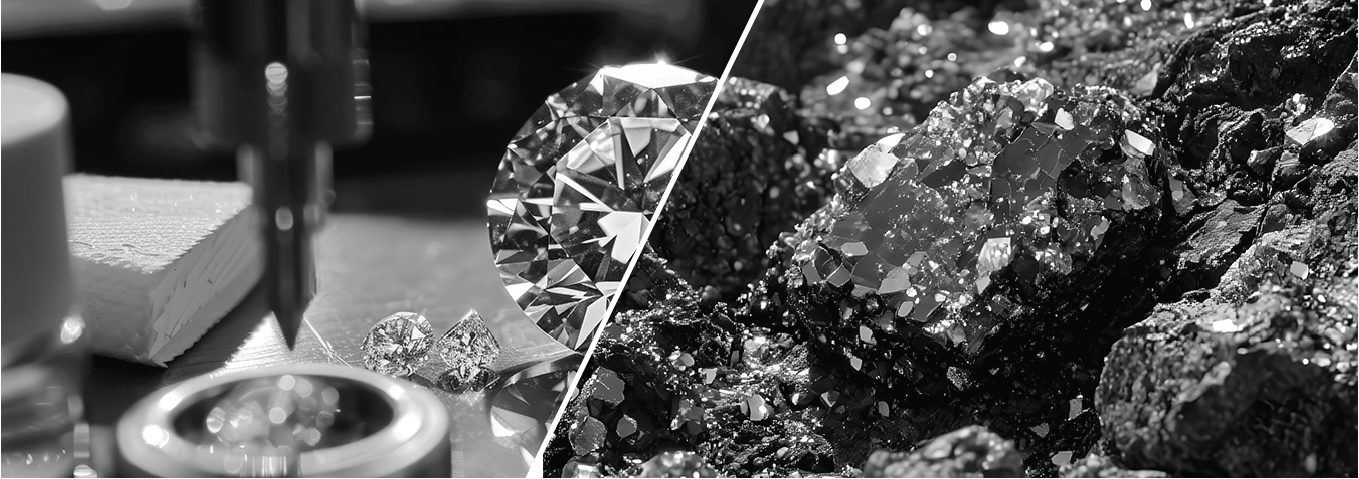
What Are Lab-Grown Diamonds? Everything You Need to Know (2026 Guide)
The world of fine jewelry is changing. More buyers than ever are choosing laboratory grown diamonds for engagement rings, wedding bands, and everyday pieces - and for good reason. This guide covers everything you need to know: what lab grown diamonds are, how they are made, how they compare to natural and simulated alternatives, and how to choose one with confidence.
Diamond growth has come a long way since General Electric's early industrial experiments in the 1950s. What began as small, dark crystals intended for cutting tools has evolved into a refined process capable of producing gem-quality stones suitable for fine jewellery.
HPHT - High Pressure, High Temperature
The HPHT method recreates the extreme heat and pressure found deep beneath the earth's surface. A diamond seed is placed inside a growth chamber alongside a carbon source and a metal flux, then subjected to pressures exceeding 5 GPa and temperatures above 1,400 °C. Under these conditions, carbon atoms dissolve in the molten metal and gradually crystallise onto the seed. HPHT diamonds require high pressure and high temperature to form and are often used for smaller stones, fancy-colour production, and post-growth colour treatments.
CVD - Chemical Vapour Deposition
Chemical vapor deposition CVD takes a different approach. A thin diamond seed plate is placed inside a vacuum chamber filled with a methane-rich gas mixture. Energy - typically microwave plasma - breaks the gas into carbon atoms, which deposit onto the seed layer by layer at temperatures between 700 °C and 1,300 °C. CVD diamonds were first produced in the 1950s, but the method gained commercial momentum in the 2000s once engineers achieved the purity and consistency needed for colourless, high-clarity gemstones. Today, CVD is favoured for larger stones and is the method used in Maitri's production.
Both methods start with a tiny diamond seed, and lab grown diamonds can be produced in weeks rather than the billions of years required underground. Whether a stone is grown by HPHT or CVD does not change its status as a genuine diamond - both are graded and certified by laboratories such as GIA and IGI. A dedicated CVD vs. HPHT guide will explore the technical distinctions in greater depth.
Grown and natural diamonds are the same material at the atomic level, but they differ in where, how long, and at what cost they are formed. The table below summarises the key distinctions.
Origin — Lab Grown Diamond: Grown in a laboratory over weeks to months. Natural Diamond: Formed deep in the earth's mantle 1-3+ billion years ago.
Chemical composition — Lab Grown Diamond: Pure carbon, identical crystal structure. Natural Diamond: Pure carbon, identical crystal structure.
Rarity — Lab Grown Diamond: Reproducible; supply scales with production capacity. Natural Diamond: Finite geological supply; rarer at high grades.
Environmental impact — Lab Grown Diamond: Significantly lower land disturbance, water use, and waste. Natural Diamond: Mining involves heavy land disruption, water consumption, and mineral waste.
Ethics & traceability — Lab Grown Diamond: Certified conflict free; traceable from seed to polish. Natural Diamond: Improving through initiatives like the Kimberley Process, but traceability remains complex.
Resale value — Lab Grown Diamond: Generally weaker secondary market. Natural Diamond: Tends to retain more value (30-50% of retail).
Availability of large, high-grade stones — Lab Grown Diamond: More accessible for a given budget. Natural Diamond: Exponentially more expensive as size and quality increase.
Lab grown diamonds are often more affordable than mined diamonds - typically costing 30% to 50% less per carat for comparable quality, and the gap widens significantly for larger sizes. This means buyers can choose a larger carat weight or higher clarity grades for the same budget. Lab grown diamonds also offer greater supply-chain transparency than mined diamonds, and they are manufactured in controlled environments, avoiding many concerns related to diamond mining.
Lab grown diamonds have a significantly lower environmental impact than mined diamonds: reduced land disturbance, lower water consumption, and fewer carbon emissions when facilities use renewable energy. The diamond market has been impacted by the rise of lab grown diamonds, with lab-grown centre stones now accounting for over 50% of engagement ring sales at some major retailers.
Resale prices for both types are difficult to predict, but lab grown diamonds generally have lower resale value compared to natural diamonds. Buyers should view a lab diamond as a purchase for personal enjoyment and meaning, not as an investment vehicle.
Not everything that sparkles is a diamond. Diamond simulants are materials that resemble a diamond's physical appearance but possess entirely different chemical and optical properties.
• Cubic zirconia (CZ) is made of zirconium dioxide. It rates around 8-8.5 on the Mohs scale, scratches more easily, and tends to display a glassy quality rather than the crisp brilliance of a diamond. CZ is very inexpensive and is not graded or certified as a diamond.
• Moissanite is silicon carbide, rated 9.25 Mohs. It has higher dispersion than diamond, producing more rainbow fire - sometimes described as a "disco-ball" effect. Its refractive index and the way light interacts with the stone differ noticeably from diamond under close inspection.
Lab grown diamonds share the same crystal structure, the same optical properties, and the same brilliance as their natural counterparts. Simulants do not. This is the fundamental difference between lab grown diamonds and look-alike alternatives.
When you buy lab grown diamonds online, always request a grading report from GIA or IGI to confirm the stone is a genuine grown diamond rather than a simulant. A separate guide comparing lab diamonds, moissanite, and CZ in detail is forthcoming.
Lab grown diamonds are graded using the same 4Cs as mined diamonds: cut, colour, clarity, and carat weight. The scales, terminology, and assessment methods are identical.
Cut — What It Measures: Proportions, symmetry, polish - how well light interacts with the stone. Lab Grown Diamond Note: Prioritise Excellent or Ideal cut grade for maximum sparkle.
Colour — What It Measures: Absence of colour, graded D (colourless) to Z (light yellow). Lab Grown Diamond Note: Lab diamonds often offer higher colour grades for the same budget; fancy colours like pink, blue, and yellow are also available.
Clarity — What It Measures: Presence of inclusions visible under magnification or to the naked eye. Lab Grown Diamond Note: Inclusions in lab grown diamonds often have unique patterns; VS-SI ranges typically offer strong value.
Carat — What It Measures: Weight of the stone (1 carat = 0.2 g). Lab Grown Diamond Note: Lab grown pricing makes 1.00-2.50 ct centre stones more attainable for engagement rings.
Cut is the single most important factor in determining a diamond's sparkle and light performance. Whether you prefer a round brilliant, oval, emerald, or pear shape, a superior cut grade ensures the stone displays the same shine and fire buyers expect. Shapes are covered in our diamond shapes guide.
Colour in diamonds is graded from D (colourless) to Z (light yellow). Many buyers find that near-colourless grades (G-J) offer excellent value in lab diamonds, as the subtle warmth is difficult to detect once set. Lab grown diamonds can also exhibit unique colours such as pink, blue, and yellow through controlled impurity doping.
Clarity measures the presence of inclusions or imperfections in diamonds. CVD-grown stones frequently fall in the VS to SI range, where any internal characteristics are not inclusions visible to the unaided eye. Higher clarity grades - VVS and above - are also readily available.
Carat weight is a measure of weight, not size, though the two are correlated. Because lab grown diamonds are cheaper per carat, buyers routinely move up to a larger stone without exceeding their budget. A dedicated guide to the 4Cs will offer deeper analysis with visual examples.
Independent gem certification protects buyers and creates a transparent, verifiable record of quality and origin. Every lab grown diamond from a reputable source is independently certified by a recognised gemological institute.
Leading laboratories - including the International Gemological Institute (IGI) and the Gemological Institute of America (GIA) - issue grading reports specifically labelled for laboratory grown diamonds. A typical report includes:
• Full 4Cs grades (cut grade, colour, clarity, carat weight)
• Measurements and proportions
• Fluorescence
• Growth method (CVD or HPHT)
• Post-growth treatment disclosure
• Laser inscription on the girdle with report number and "laboratory grown" designation
It is worth noting that a grading report from a reputable lab is not the same as a generic "certificate of authenticity" card from a retailer. An assurance lab like GIA or IGI applies rigorous, independently certified standards. GIA's iD100® screening device can identify lab grown diamonds in under two seconds using advanced testing and spectroscopic analysis, ensuring accurate separation from natural stones even when specialised equipment is not available at the point of sale.
Lab grown diamonds are produced using CVD or HPHT methods, and modern reports increasingly disclose which method was used and whether the stone has undergone post-growth treatment.
Laboratory grown diamonds are still relatively new to many buyers, so outdated information circulates widely. Here are the most persistent myths - and the facts.
"Lab grown diamonds aren't real." They are. Are lab grown diamonds real? Absolutely. They possess identical physical and chemical properties to mined diamonds - the same hardness, the same physical characteristics, and the same optical performance. The FTC recognised lab grown diamonds as real diamonds in 2018, removing any ambiguity.
"They look fake." To the naked eye, a lab grown diamond and a natural diamond are optically identical. Standard thermal diamond testers cannot distinguish between them. Only specialised equipment using photoluminescence or spectroscopic analysis can identify the growth method.
"They're too new to trust." Industrial engineered diamonds have been grown since the 1950s. Gem-quality stones have been set in fine jewelry for decades. The science is well established.
"They won't last." A lab grown diamond has the same hardness - 10 on the Mohs scale - as any natural diamond. It will not fade, cloud, or degrade under everyday wear. The term "synthetic" sometimes causes confusion because in other industries it implies inferior quality, which is why the jewellery trade now prefers lab grown or lab created.
Every purchase involves trade-offs. Understanding both sides helps buyers make a decision aligned with their priorities.
Advantages
Lab created diamonds deliver significantly better value per carat. On the same budget - say $3,000 - a buyer might choose a 0.70-0.80 ct natural G/VS2 or a 1.50-2.00 ct lab grown of similar or better quality. That makes previously aspirational sizes (1.50-3.00 ct) achievable for more couples choosing engagement rings.
The transparent, traceable origin of a lab diamond means buyers know exactly where and how their stone was grown - a mining free alternative that sidesteps the ethical and environmental complexities of traditional diamond mining. Lab grown diamonds are considered more sustainable than mined diamonds, particularly when produced using renewable energy.
Lab grown diamonds can also exhibit unique colours such as pink, blue, and yellow with greater consistency than natural fancy-colour stones, opening creative possibilities for designers and collectors alike.
Potential Drawbacks
Lab grown diamonds generally have a softer resale market. Wholesale prices have declined steeply since 2020, and the secondary market for pre-owned lab stones remains thin. Buyers should purchase for personal enjoyment rather than with expectations of recovering their investment.
Some collectors and traditionalists place sentimental value on the geological rarity and age of natural diamonds - a perspective that is entirely valid. Additionally, the environmental benefit depends on the energy source powering the laboratory; facilities running on fossil fuels may narrow the carbon-footprint advantage.
For B2B buyers - jewellery designers, retailers, and wholesalers - price volatility and supply trends are important to monitor. Partnering with a stable, vertically integrated producer helps manage these risks.
There is no universally "better" choice. The difference between lab grown and natural diamonds comes down to each buyer's values, aesthetic preferences, and financial expectations.
Choosing a lab diamond for an engagement ring or other important piece is straightforward when broken into clear steps.
Step 1 - Define your priorities. Decide whether size, overall sparkle, colourlessness, or clarity matters most. For engagement rings, a common priority order is Cut → Carat → Colour → Clarity.
Step 2 - Set a realistic budget. Lab grown diamonds in 2026 allow, for example, a 1.50 ct stone for roughly the price of a 0.80-1.00 ct natural of similar quality. Fix a maximum spend before browsing.
Step 3 - Choose a shape. Popular shapes include round brilliant (maximum sparkle), oval (elongated elegance), emerald (architectural clarity), radiant, cushion, and pear. Some shapes - like oval and radiant - appear larger for the same size, offering additional perceived value. A rough diamond is cut and polished into these shapes by skilled craftspeople, regardless of whether it originated from a mine or a reactor.
Step 4 - Select 4C ranges. A practical starting point for a bright solitaire: Excellent/Ideal cut, G-H colour, VS2-SI1 clarity, 1.00-1.50 ct. Adjust based on your priorities and budget.
Step 5 - Verify certification. Always choose a lab diamond graded by IGI, GIA, or an equivalent independent lab. Check that the report number matches the stone and that the report clearly states "laboratory grown."
Step 6 - Consider the setting. Solitaire, halo, three-stone, and pavé band designs each frame the diamond differently. Metals such as 18K yellow, white, and rose gold or platinum each affect the overall aesthetic. For wedding bands and complementary pieces, consistency in metal choice creates a cohesive look.
Maitri Lab Grown Diamonds supports both private clients and trade partners with curated selections, custom designs, and fully traceable CVD-grown stones. Explore wholesale options or browse retail collections to find the right stone.
Care for a lab grown diamond ring or necklace is identical to care for a natural diamond - because it is the same material with the same properties.
• Home cleaning: Soak in warm water with a few drops of mild dish soap for 20-30 minutes. Gently brush with a soft toothbrush, paying attention to the underside of the stone where residue accumulates. Rinse thoroughly and dry with a lint-free cloth.
• Avoid: Chlorine bleach, abrasive cleaners, and ultrasonic cleaners with harsh solutions. Remove rings before heavy manual work or gym sessions to protect the setting, not the stone.
• Professional check-ups: Visit a jeweller once or twice a year to inspect prongs and settings, especially for pieces worn daily like engagement rings and wedding bands.
A lab diamond does not become cloudy or dull internally. Any loss of sparkle is surface residue - oils, lotions, soap - that proper cleaning removes immediately.
Are lab grown diamonds real diamonds?
Yes. Lab grown diamonds are chemically identical to mined diamonds. They share the same material - pure crystalline carbon - the same hardness, and the same optical properties. The federal trade commission formally recognised them as real diamonds in 2018.
Are lab grown diamonds as hard and durable as mined diamonds?
They are. Both score 10 on the Mohs scale, making them the hardest known natural material. A lab diamond will not scratch, chip, or degrade any differently from a natural stone under everyday wear.
Can you tell the difference between lab grown and natural diamonds?
Not with the naked eye. Lab grown and natural diamonds are optically identical in physical appearance. Only advanced testing using specialised equipment - such as photoluminescence spectroscopy or GIA's iD100® - can distinguish them.
Are lab grown diamonds suitable for engagement rings and wedding bands?
Absolutely. Their exceptional hardness and durability make them ideal for pieces worn every day. The same size and quality that might be out of reach in a natural stone often becomes attainable as a lab diamond.
Do lab grown diamonds come in different shapes and colours?
Yes. Lab grown diamonds are available in every popular shape - round, oval, emerald, cushion, pear, radiant, marquise, and more. They can also exhibit unique colours such as pink, blue, and yellow, produced through precise control of growth conditions.
How are lab grown diamonds graded?
Lab grown diamonds are graded by the same standards as mined diamonds, using the 4Cs: cut, colour, clarity, and carat weight. Reports are issued by recognised bodies like the gemological institute of America (GIA) and the international gemological institute (IGI).
Will lab grown diamonds keep their value?
Lab grown diamonds generally have lower resale value than natural diamonds. Wholesale prices have declined significantly in recent years, and the secondary market is still developing. They are best viewed as a purchase for personal meaning and enjoyment.
Can a lab grown diamond be resized or reset?
Yes. Because lab grown diamonds share the same hardness and structural properties as natural diamonds, they can be resized, re-set, or redesigned by any qualified jeweller without limitation.
Are lab grown diamonds more sustainable?
Lab grown diamonds are considered more sustainable than mined diamonds. They require no large-scale excavation, generate far less mineral waste, and use significantly less water. When produced in facilities powered by renewable energy - as in Maitri's climate-neutral operations - the carbon footprint is substantially lower than that of traditional diamond mining.
How long have lab grown diamonds been available?
The first synthetic diamonds were produced in the 1950s for industrial purposes. Gem-quality stones entered the jewellery market in the 2000s, and production has scaled rapidly since 2020.
A laboratory grown diamond is, in every measurable way, a genuine diamond. It offers the same brilliance, the same durability, and the same beauty as a stone formed deep underground - distinguished only by its origin and the values it represents.
The right choice between a lab grown and a natural diamond depends on your priorities: budget, sustainability, tradition, and what you want the stone to symbolise. Neither option is inherently superior; both are real diamonds graded to the same standards.
We encourage you to continue exploring our educational guides - from the 4Cs and certification to CVD vs. HPHT and lab grown diamond pricing - so that when you are ready to buy, you do so with clarity and confidence. Maitri Lab Grown Diamonds designs, grows, and finishes fully traceable CVD lab diamonds and jewellery collections for both retail clients and wholesale partners seeking high-quality, climate-neutral stones.