

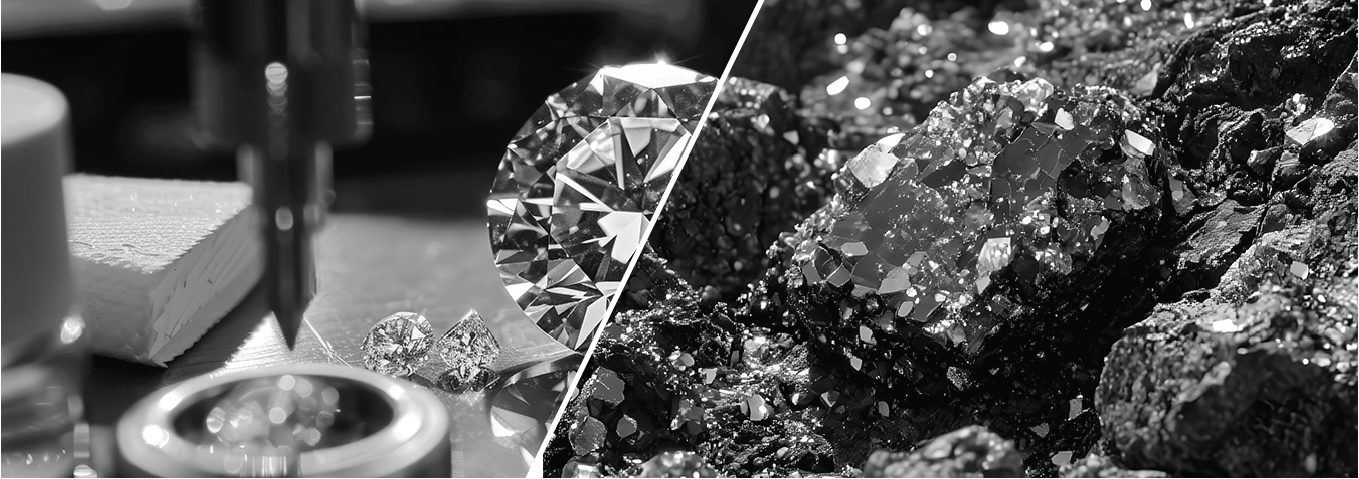
Lab-Grown Diamonds vs Natural Diamonds: Which Should You Choose?
Choosing between a lab-grown diamond and a natural diamond isn't really a question of quality. Both are genuine diamonds, identical in chemical composition, hardness, and visual brilliance. The real differences lie in origin, rarity, price, and what each stone represents to the person wearing it. This guide walks through the distinctions that actually matter, so you can decide with confidence.
Both are pure carbon arranged in a cubic lattice. The difference is entirely in how and where that carbon crystallised.
Natural diamonds crystallised roughly 140-200 km beneath the surface, under pressures exceeding 5 gigapascals and temperatures above 1,200°C, over the course of one to three billion years. Volcanic activity later carried them toward the surface through kimberlite and lamproite pipes, where they were eventually mined. Many natural stones carry tiny mineral inclusions, effectively geological fingerprints of that journey.
Lab-grown diamonds are produced using one of two methods: HPHT, which recreates the pressure and heat conditions of natural formation using a metal catalyst, and CVD, which builds a diamond layer by layer from carbon-rich gas onto a seed crystal. Both yield genuine crystalline diamond within weeks, not simulants like cubic zirconia or moissanite, which are chemically unrelated to diamond altogether, and brands such as Maitri's future-focused lab-grown diamonds showcase how advanced CVD can turn that science into fine jewellery.
Because lab-grown and natural diamonds share an identical atomic structure, their physical and optical properties are functionally the same:
• Hardness: both score 10 on the Mohs scale, the maximum possible rating.
• Refractive index: approximately 2.417-2.419 for both, which governs brilliance and fire.
• Thermal conductivity: identical, meaning both register correctly on standard diamond testers.
• Optical performance: dispersion, lustre, and scintillation are indistinguishable at equivalent cut quality.
This matters practically: even trained gemologists need specialised equipment, such as spectroscopes, cross-polarised light, or UV fluorescence analysis, to determine origin. To the naked eye, a well-cut lab-grown stone and a natural diamond of the same colour and clarity grade look the same. Lab-grown diamonds sometimes show fewer impurities, which can push clarity grades higher, while natural stones may carry mineral traces that natural-diamond buyers often view as part of the stone's character rather than a flaw.
Brilliance depends far more on cut quality than on where a diamond formed. For stones matched on cut, colour, and clarity, a lab-grown and a natural diamond perform identically under light. This is why the 4Cs, not origin, remain the framework that actually predicts how a diamond will look.
Some earlier-generation CVD stones showed faint brownish or grayish tints, and early HPHT stones occasionally carried a slight blue cast. Growth technology has largely resolved this, and any residual tint should appear on the grading report regardless of origin.
Brilliance and fire — Lab-Grown Diamonds: Identical when well cut. Natural Diamonds: Identical when well cut.
Colour range — Lab-Grown Diamonds: Full spectrum, including vivid fancy colours. Natural Diamonds: Full range; rare fancy colours carry a premium.
Inclusions under magnification — Lab-Grown Diamonds: Metallic flux lines (HPHT) or growth striations (CVD). Natural Diamonds: Mineral inclusions, strain lines, natural crystals.
Supply consistency — Lab-Grown Diamonds: Uniform, controlled output. Natural Diamonds: Variable, dependent on mine yield.
Cut quality should be your first consideration in either case. It affects appearance more than any other factor.
Both types are equally suited to daily wear. A Mohs hardness of 10 means only another diamond can scratch either stone, which is why diamonds remain the standard choice for engagement rings and other jewellery worn every day.
Hardness isn't the same as toughness, though. Toughness relates to resistance to chipping, and both lab-grown and natural diamonds perform similarly here: either can chip if struck at the wrong angle. In practice, setting style has a bigger effect on long-term durability than origin does: a low-profile bezel setting protects a stone far better than a high, exposed prong setting, regardless of whether the diamond was mined or grown.
Neither type fades or clouds over time. Any dulling in appearance is almost always surface residue, not a change in the stone itself, and it resolves with routine cleaning and an annual prong check from a jeweller.
Retail prices shift constantly with demand and production costs, which is why percentage comparisons are more useful than fixed figures. As a general rule, lab-grown diamonds run 50-70% cheaper than natural stones of comparable cut, colour, clarity, and carat weight. That gap exists because CVD production scales more easily than mining, and lab supply chains involve fewer intermediaries and no large-scale extraction infrastructure.
Resale is where the two diverge most. Neither lab-grown nor most natural diamonds should be treated as a financial investment. Natural diamonds tend to retain more resale value, often recovering somewhere around 30-50% of original retail through reputable channels, because scarcity supports a floor price. Lab-grown diamonds don't have that same floor: as production scales and costs fall further, resale values have been trending downward, compressing what a buyer can expect to recoup.
Purchase price (same 4Cs) — Lab-Grown Diamonds: 50-70% lower. Natural Diamonds: Higher, reflecting rarity and mining costs.
Resale market depth — Lab-Grown Diamonds: Limited, fewer active buyers. Natural Diamonds: Broader, more established channels.
Long-term price trend — Lab-Grown Diamonds: Likely to keep declining. Natural Diamonds: More stable, supported by finite supply.
If resale isn't a priority for you, the price difference on the purchase side is often the more relevant number: it's what lets buyers secure a larger stone or a more elaborate setting for the same budget.
Environmental impact varies across individual mines and labs, so broad claims in either direction oversimplify things. That said, the averages are informative: lab-grown diamonds generally use less energy and water per carat than mined diamonds, and land disturbance is minimal by comparison. CVD tends to have a lighter energy footprint than HPHT, though both depend on the carbon intensity of the electricity grid powering the facility, and some producers now focus on sustainable, traceable, climate-neutral lab-grown diamonds powered by renewables. A lab running on coal-heavy power isn't automatically "greener" than a well-run mine.
Natural diamond mining involves open-pit or underground extraction, with associated habitat disruption and community impact. Some operations run credible environmental rehabilitation and community investment programmes; others don't. The Kimberley Process addresses conflict sourcing at the rough-stone stage, but traceability weakens considerably after cutting and polishing, which is worth keeping in mind if conflict-free sourcing matters to you.
Questions worth asking any seller, lab-grown or natural:
• What energy source powers production or mining?
• Is there third-party sustainability verification?
• Can the diamond be traced to a specific facility or mine of origin?
Natural diamonds are finite in a way that matters practically, not just poetically. They formed under specific geological conditions over a billion-plus years, and nothing is replacing that supply on a human timescale. That scarcity (especially for larger stones, higher clarity grades, or fancy colours) is a real driver of both price and perceived prestige.
Lab-grown diamonds don't carry that same scarcity, since production can scale as technology improves. Their rarity, where it exists, relates to specific quality combinations rather than a limited supply of the material itself. A flawless five-carat lab-grown diamond is still uncommon today, but it's reproducible in a way a natural equivalent simply isn't.
Which of these matters more is genuinely personal. Some buyers are drawn to the idea that their stone endured immense pressure and heat over geological time. Others find equal or greater meaning in choosing a diamond that reflects deliberate, lower-impact production and even contributes to community-focused social impact initiatives. Neither view is more correct; they're just different value systems, and a good jeweller should be able to support either one without steering you.
Both lab-grown and natural diamonds should come with an independent grading report from a recognised gemological laboratory, such as GIA, IGI, or HRD. These labs apply the same grading standards to both origins, assessing cut, colour, clarity, and carat weight, along with fluorescence and any treatments. The US Federal Trade Commission also requires clear disclosure of a diamond's origin at the point of sale, so a legitimate seller will state plainly whether a stone is lab-grown or natural.
Lab-grown diamonds are typically laser-inscribed on the girdle with their report number and the words "lab-grown," which makes verification straightforward. Natural diamonds vary more in traceability: chain-of-custody and blockchain tracking programmes exist but remain inconsistent across the industry, whereas some lab producers offer fully traceable, climate-neutral CVD diamonds with end-to-end transparency.
Whatever you're buying, insist on:
• An independent grading report with a report number you can verify online.
• A girdle inscription matching that report.
• Clear disclosure of any treatments.
• For lab-grown stones: growth method and production facility.
• For natural stones: country or mine of origin where available.
Understanding how grading reports are structured, and how different cuts affect a stone's appearance, can help you evaluate any diamond with more confidence before you buy.
Choose lab-grown if you want to maximise size, clarity, or setting complexity within a fixed budget, and if reduced mining impact and production transparency matter to you more than resale value or geological rarity.
Choose natural if geological scarcity, cultural tradition, or a stronger secondary market are genuinely important to you, and you're comfortable paying more for the same size and quality in exchange for that rarity.
Neither option is objectively better. The right choice depends on what you value: budget flexibility and sustainability, or rarity and long-term tradition. Whichever you choose, prioritise cut quality and independent certification above all else; those two factors will affect how your diamond looks and how confidently you can verify what you bought, regardless of where it came from.
For readers exploring the lab-grown side of this decision, producers such as Maitri Lab Grown Diamonds publish full CVD growth traceability, which is worth reviewing as part of your own research process.