

How Lab-Grown Diamonds Are Tested and Identified
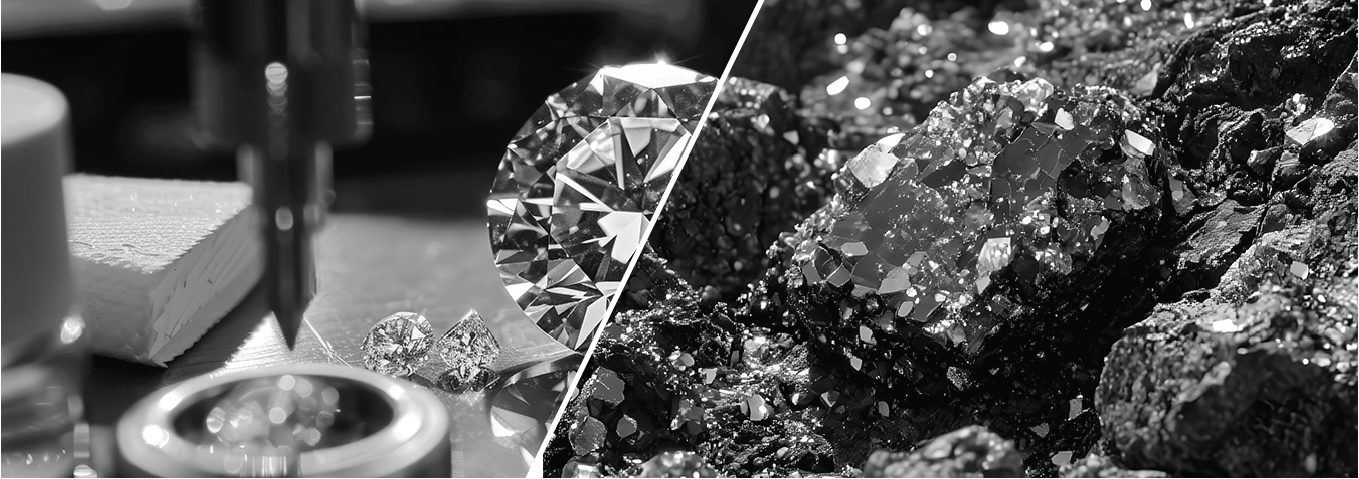
Put a lab-grown diamond next to a mined diamond and even an experienced jeweler cannot reliably tell which is which by looking. This is not because the lab-grown stone is a convincing imitation. It is because it is a diamond. Both are made of carbon atoms arranged in the same cubic crystal structure, and both share the same hardness, brilliance, and fire.
So how is a diamond’s origin confirmed? The answer is in how it grew. A diamond that formed over billions of years deep within the earth carries different evidence from one grown in weeks inside a reactor. Gemological laboratories use specialized equipment to read that evidence. This guide explains how the process works and what it means for anyone buying diamonds.
Why Natural and Lab Diamonds Are So Hard to Tell Apart
Do Lab-Grown Diamonds Pass a Diamond Tester?
How Growth Leaves a Fingerprint
Yes. This surprises many people, but it makes sense once you know what a standard diamond tester measures.
Most handheld testers check thermal conductivity, meaning how quickly a gemstone conducts heat away from the probe tip. Diamond moves heat exceptionally well, far better than glass or cubic zirconia. Since lab-grown diamonds are diamond, they pass the test exactly as mined stones do.
Many testers also measure electrical conductivity to separate diamond from moissanite, which conducts heat well but also conducts electricity. One quirk is worth knowing: some HPHT diamonds contain boron, which makes them electrically conductive, so a multi-tester may misread them as moissanite.
The key point is that a diamond tester answers one question: “Is this a diamond?” It does not tell you where the diamond came from. Some handheld devices are marketed specifically to detect lab grown diamonds, but these are screening tools. They flag stones that need further testing rather than delivering a final verdict.
To identify lab grown diamonds, gemologists look for traces of the formation process. Lab-grown diamonds are produced using two primary methods, and each leaves its own signature.
HPHT (High Pressure, High Temperature): HPHT recreates the conditions of diamond formation in the mantle. A small diamond seed is placed with a carbon source and a metal solvent, then subjected to extreme pressure and high temperature. Carbon dissolves in the molten metal and crystallizes onto the seed. HPHT diamonds typically grow in a cuboctahedral shape, combining cube and octahedral faces.
CVD (Chemical Vapor Deposition): CVD grows a diamond layer by layer. Thin diamond seed plates sit in a vacuum chamber filled with a carbon-rich gas, usually methane mixed with hydrogen. Energy breaks the gas apart, and carbon atoms settle onto the seed and build upward. Many CVD diamonds are later given an HPHT treatment to improve their color, which laboratories can also detect.
The Clues Gemologists Look For
Diamond Type and Nitrogen Impurities
Growth Patterns Under UV Light
Inclusions
Strain Patterns
Spectroscopy: The Definitive Step
When exposed to intense short-wave UV light, a diamond’s internal growth structure becomes visible. Natural diamonds usually show irregular or concentric growth zones. HPHT diamonds reveal distinct geometric sectors from their cuboctahedral growth. CVD diamonds often display fine parallel striations from layered deposition. Some HPHT stones also phosphoresce, glowing briefly after the UV source is switched off.
Inclusions are often the clearest visual clue. HPHT diamonds can contain metallic inclusions from the metal solvent, sometimes enough to make a stone respond to a strong magnet. CVD diamonds may show dark specks of non-diamond carbon. Natural diamonds, by contrast, can hold tiny crystals of other minerals that formed alongside them underground, something a lab cannot produce.
Many lab-grown diamonds are very clean, however, so inclusions alone are rarely conclusive.
Viewed between crossed polarizing filters, diamonds reveal internal strain. Natural Type IIa diamonds often show a fine crosshatched pattern, while CVD diamonds tend to show columnar or banded strain that follows their growth direction.
The most reliable ways to analyze diamonds use spectroscopy, which measures exactly which wavelengths of light a diamond absorbs or emits. These advanced technologies detect atomic-level defects that no visual inspection could reveal.
Infrared spectroscopy confirms diamond type by measuring nitrogen. Photoluminescence spectroscopy, often performed with the stone cooled in liquid nitrogen, detects defects linked to specific growth methods, such as silicon-related features common in CVD diamonds or nickel-related features in HPHT diamonds.
Testing Methods at a Glance
| Testing method | What it reveals | Separates natural from lab-grown? |
|---|---|---|
| Thermal diamond tester | Heat conductivity | No |
| Loupe or microscope | Inclusions, clarity features | Sometimes, if inclusions are present |
| UV imaging | Growth patterns, fluorescence | Strong indicator |
| Polarized light | Internal strain | Supporting evidence |
| Infrared spectroscopy | Diamond type, nitrogen content | Screening indicator |
| Photoluminescence spectroscopy | Atomic-level defects | Yes, in combination with other tests |
No single test is used in isolation. Gemological laboratories combine screening, imaging, and spectroscopy to reach a confident conclusion.
The Grading Report and Girdle Inscription
What This Means When Buying Diamonds
Frequently Asked Questions
Conclusion
Understanding how testing works helps you avoid the most common mistakes:
• Do not rely on a handheld tester. Passing confirms a diamond, not a natural one.
• Ask for an independent grading report. Check that the report number matches the girdle inscription.
• Expect clear disclosure. Reputable sellers describe stones as lab grown, laboratory grown, or lab created without ambiguity.
• Do not treat “lab grown” as “lower quality.” Origin and quality are separate. A lab-grown diamond is graded on the same scale as a mined diamond, and no diamond is a perfect diamond simply because of where it formed.
Whether you are choosing loose lab grown diamonds for a single piece or sourcing wholesale lab grown diamonds for a jewelry business, working with a lab diamond supplier that provides independent certification is the simplest form of quality assurance available.
Can a jeweler tell if a diamond is lab grown?
Not by eye or with a loupe alone. A jeweler can read the girdle inscription or send the stone to a gemological laboratory, but confirming origin from scratch requires advanced testing equipment.
Are lab-grown diamonds real diamonds?
Yes. They have the same chemical composition, crystal structure, and properties as natural diamonds. Only their origin differs.
Can a lab-grown diamond be identified without a certificate?
Yes, but only by a laboratory or a trained gemologist with sophisticated tools such as UV imaging and spectroscopy.
Will a lab-grown diamond change over time?
No. Like any diamond, it is extremely durable and will not cloud, fade, or lose its brilliance.
Lab-grown diamonds pass a diamond tester because they are diamonds, identical to natural stones in every property you can see or measure at home. What separates natural and synthetic diamonds is their growth history, revealed through nitrogen content, growth patterns, inclusions, strain, and spectroscopic signatures. For buyers, the answer is straightforward: choose stones with an independent grading report and a matching girdle inscription, and you will always know exactly what you own.