

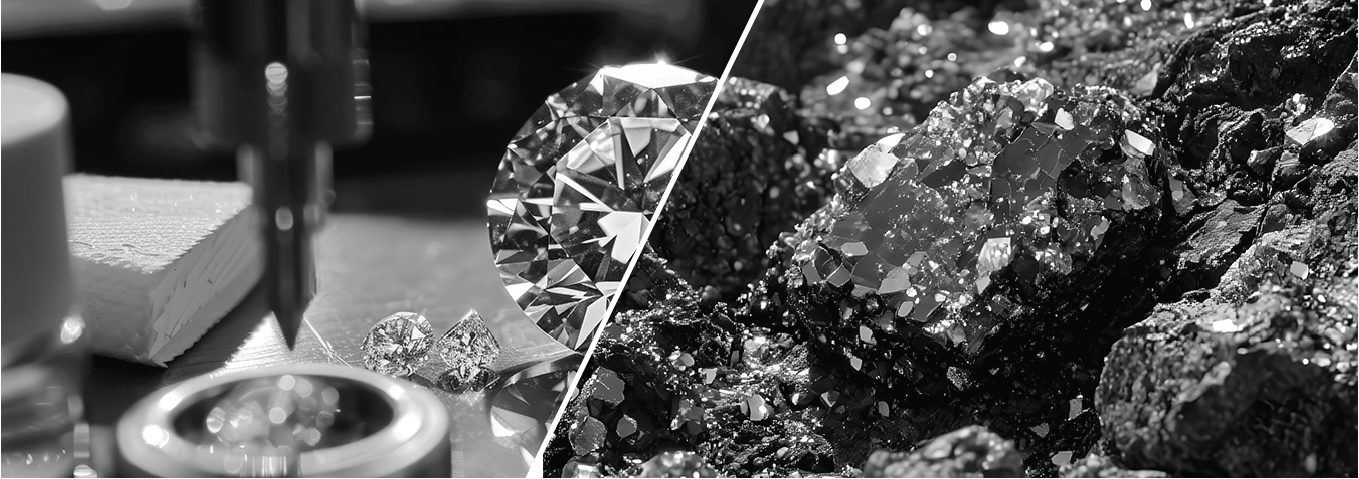
The Sparkling Rise of Lab-Grown Diamonds: How They Went Mainstream
A decade ago, walking into a jewelry store and asking for a lab-grown diamond might have earned a puzzled look. Today, that same request is one of the most common conversations happening in fine jewelry. Lab-grown diamonds have moved from a curious alternative to a mainstream choice, and for good reason. They offer real diamonds, with the same fire, brilliance, and chemical structure as mined stones, at a meaningful price difference and with a transparent supply chain. Understanding how this shift happened, and what actually separates lab diamonds from natural diamonds, helps buyers make a confident, informed decision.
What Are Lab-Grown Diamonds?
How Lab-Grown Diamonds Are Made
Understanding the manufacturing process helps explain why lab diamonds are genuine diamonds rather than a synthetic substitute. Two methods dominate the industry today: High Pressure High Temperature and Chemical Vapor Deposition.
High Pressure High Temperature (HPHT)
The HPHT method traces its roots back to the 1950s, when researchers including Tracy Hall at General Electric first successfully replicated the intense heat and crushing pressure that natural diamonds experience within the earth's crust. Early diamonds produced this way proved that creating diamonds outside nature was possible, something once thought impossible.
The process begins with a small diamond seed placed inside a machine, often a belt press, capable of generating extreme pressure and high temperature. A carbon source is introduced, and under these conditions the carbon atoms bond to the seed, growing a diamond layer by layer until a full crystal forms.
Chemical Vapor Deposition (CVD)
Chemical vapor deposition works differently. A diamond seed is placed inside a sealed chamber filled with a carbon rich gas, typically methane. The chamber is heated, and the gas is ionized into plasma, which causes carbon atoms to settle onto the seed and build a diamond crystal from the bottom up. Early CVD diamonds were smaller and less consistent than they are now, but technological advancements over the past two decades have made CVD one of the most widely used methods in the industry, producing lab grown stones of exceptional quality.
Both methods result in a genuine diamond built from pure carbon, indistinguishable from a mined diamond to the naked eye and, in most cases, without specialized equipment.
Lab-Grown vs. Natural Diamonds: What's Actually Different
Because lab grown diamonds and mined diamonds share an identical chemical structure, the real differences lie in how they are formed and sourced, not in what they are made of.
| Factor | Lab-Grown Diamonds | Natural Diamonds |
|---|---|---|
| Formation | Created in weeks using HPHT or CVD | Formed over billions of years in the earth's mantle |
| Chemical structure | Pure carbon, identical to mined diamonds | Pure carbon |
| Optical properties | Optically identical, same fire and brilliance | Same fire and brilliance |
| Supply chain | Traceable from creation to sale | Can involve complex, harder-to-trace mining and trading routes |
| Environmental impact | Lower carbon footprint, especially when grown using renewable energy | Traditional diamond mining can involve significant environmental damage |
| Price | Generally more affordable for comparable quality | Generally higher priced for comparable quality |
Grading labs confirm that lab-grown and natural diamonds are optically identical and structurally the same, which is why standard jewelers' loupes and even many trained eyes cannot tell them apart. Distinguishing between the two requires specialized detection equipment that reads subtle growth patterns invisible to the naked eye.
Why Lab-Grown Diamonds Went Mainstream
Quality Standards and Certification
What to Consider When Buying Lab-Grown Diamonds
Why Choose Maitri
Frequently Asked Questions
Ready to Explore Lab-Grown Diamonds?
Not all lab grown stones are created equal, and certification is the clearest way to verify quality. Reputable grading labs independently assess each stone's cut, color, clarity, and carat weight, then issue a report confirming those findings along with the diamond's laboratory-grown origin. Our Igi certified lab grown diamonds collection reflects this standard, with every stone graded by an internationally recognized laboratory before it reaches a customer.
A certificate does more than confirm authenticity. It gives buyers an objective basis for comparing stones and understanding exactly what they are paying for, rather than relying on a jeweler's description alone. When evaluating any lab diamond, always ask for the grading report and confirm which laboratory issued it.
Buying a diamond, lab-grown or natural, is a decision worth approaching carefully. A few principles make the process easier.
Start with certification. A grading report from an established, independent laboratory should accompany any diamond purchase. Without one, there is no reliable way to confirm the stone's quality or origin.
Understand the four Cs before comparing stones. Cut has the greatest influence on how a diamond reflects light, and a well-cut lab diamond of average clarity can outperform a poorly cut stone with a higher clarity grade.
Watch for common misconceptions. One persistent myth is that lab-grown diamonds are less durable or less valuable than mined diamonds. In terms of hardness and physical properties, they are identical. Another misconception is that lab-grown means lower quality. In reality, exceptional quality lab grown stones are available across every price point, just as they are in mined diamonds.
Avoid buying without provenance documentation. A trustworthy supplier will always be transparent about how a stone was created, which laboratory graded it, and where it came from. If a seller is vague on any of these points, treat that as a warning sign rather than a minor detail.
Consider working directly with a manufacturer rather than only through multiple intermediaries. A company that both creates and supplies its diamonds typically offers greater consistency in quality, clearer pricing, and more direct accountability, since there are fewer parties between production and purchase. For buyers seeking larger quantities or better pricing structures, exploring wholesale lab grown diamonds directly from a manufacturer can also provide meaningful advantages over buying through standard retail channels.
Maitri has built its reputation on transparency and consistency across every stage of production, from the diamond seed to the finished stone. As a manufacturer with operations spanning the USA, UK, Hong Kong, and India, Maitri controls quality at the source rather than relying on third-party production, which means every diamond in our exquisite collection meets the same rigorous standard before it ever reaches a customer.
Every stone is independently graded, giving buyers the documentation needed to buy with confidence. Whether you are searching for loose lab grown diamonds to set in a custom design or sourcing lab grown diamonds for a retail collection, working directly with the manufacturer means fewer intermediaries, clearer answers, and pricing that reflects genuine production value rather than layered markups. For buyers, sourcing wholesale lab grown diamonds from an established trade supplier with competitive bulk pricing can simplify the entire purchasing process.
Are lab-grown diamonds real diamonds?
Yes. Lab-grown diamonds share the same chemical structure, crystal structure, and optical properties as natural diamonds. The only difference is where and how they were formed.
Can you tell a lab-grown diamond apart from a natural one just by looking at it?
No. Lab-grown and natural diamonds are optically identical to the naked eye. Distinguishing between them requires specialized equipment used by grading labs.
Are lab-grown diamonds a good choice for engagement rings?
Many buyers choose lab-grown diamonds for engagement rings because they allow for a larger or higher clarity stone within the same budget as a smaller natural diamond, while offering the same beauty and durability.
Do lab-grown diamonds hold their value?
Diamond pricing, whether lab-grown or natural, depends on market conditions and is not typically treated as a financial investment. Buyers should choose a diamond for its beauty and quality rather than as a speculative asset.
Why do lab-grown diamonds cost less than natural diamonds?
The price difference largely reflects the production process itself. Growing a diamond in a controlled setting over weeks generally costs less than the resource-intensive process of locating and extracting a natural diamond formed over billions of years.
Is buying lab-grown diamonds better for the environment?
Lab-grown diamond production, particularly when powered by renewable energy, generally involves a lower carbon footprint than traditional diamond mining, which can disturb large areas of land. Environmental impact still varies by producer, so it is worth asking suppliers about their specific practices.
The jewelry world has settled the question of whether lab-grown diamonds belong in fine jewelry. What remains is simply choosing the right stone and the right supplier. Whether you are shopping for a single stone or sourcing in volume, understanding how lab-grown diamonds are made and graded puts you in a stronger position to buy with confidence. Explore Maitri's lab grown diamonds collection to see the quality and craftsmanship behind every stone, or reach out to our team to discuss your specific requirements. We are happy to answer questions about certification, sourcing, or custom orders, and to help you find the right diamond for your needs, whether that means a single loose stone for a custom setting or a larger order for your own collection.