

Lab-Grown Diamonds vs Mined Diamonds: Key Differences for B2B Buyers
As the global diamond industry evolves, one of the most important conversations shaping procurement strategies is the comparison between lab-grown diamonds and mined diamonds. While consumers often approach this comparison from an emotional or aesthetic standpoint, businesses must evaluate it through a different lens. For B2B buyers such as jewellery manufacturers, wholesalers, retailers, and industrial users, the key considerations include supply stability, pricing predictability, sustainability, and long-term scalability.
Understanding how lab-grown diamonds differ from mined diamonds allows companies to make informed decisions that support both operational efficiency and long-term growth
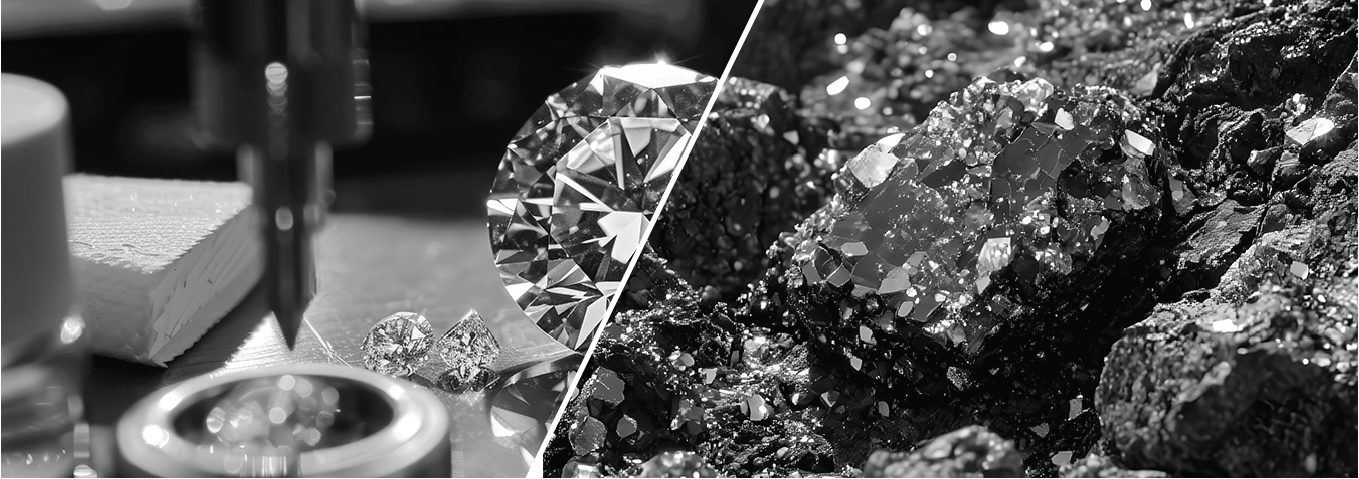
Mined diamonds are formed naturally over billions of years beneath the earth's surface under extreme heat and pressure. They are extracted through open-pit or underground mining operations spanning vast geographical areas, often in regions such as Africa, Russia, Canada, and Australia.
Lab-grown diamonds, by contrast, are produced in controlled laboratory environments using two primary methods: High Pressure High Temperature (HPHT) and Chemical Vapour Deposition (CVD). HPHT mimics the natural geological conditions that create diamonds, while CVD grows diamonds layer by layer from a carbon-rich gas. Both processes yield gem-quality diamonds in a matter of weeks rather than millennia.
For B2B buyers, understanding the origin matters because it directly affects supply reliability, lead times, and the ability to scale procurement without the geographic or geopolitical uncertainties associated with mining.
The mined diamond supply chain is long and complex, involving mines, rough diamond brokers, cutters and polishers, distributors, and retailers. This multi-layered structure introduces vulnerabilities: a single disruption in one region can affect global availability and pricing for months.
Lab-grown diamonds simplify this chain significantly. Production facilities can be located closer to manufacturing hubs, and output can be scaled up or down based on demand. For industrial buyers and manufacturers, this translates into more predictable lead times, consistent quality, and reduced dependency on commodity market volatility.
Businesses that prioritise supply chain resilience and continuity are increasingly shifting a portion of their procurement to lab-grown sources for these operational reasons alone.
Mined diamond prices are influenced by a range of unpredictable variables including geopolitical conditions, mining output, cartel dynamics, and consumer sentiment. This makes long-term cost forecasting difficult for businesses that rely on consistent margins.
Lab-grown diamonds have seen significant price reductions over the past decade as production technology has improved and capacity has scaled. While prices continue to decline gradually, the overall pricing structure is more stable and predictable for procurement planning purposes.
For B2B buyers sourcing large volumes, the cost advantages of lab-grown diamonds can be substantial. This is particularly relevant for jewellery manufacturers, industrial tool producers, and technology companies where diamond is a critical input material.
The environmental impact of diamond mining is considerable. Open-pit mining displaces large volumes of earth, disrupts ecosystems, consumes significant energy and water, and often results in long-term land degradation. While responsible mining practices exist, the inherent extraction process carries an unavoidable environmental footprint.
Lab-grown diamonds require significantly less land disturbance and, when produced using renewable energy sources, can have a dramatically lower carbon footprint per carat. Leading producers are increasingly committing to clean energy manufacturing, further improving the sustainability profile of lab-grown diamonds.
For companies with ESG commitments or sustainability reporting requirements, sourcing lab-grown diamonds provides a measurable improvement in environmental metrics without sacrificing product quality.
One of the longstanding challenges in the mined diamond industry is provenance. Despite international efforts like the Kimberley Process, ensuring that a diamond is truly conflict-free remains difficult in practice, particularly across complex, multi-party supply chains.
Lab-grown diamonds offer a fundamentally different traceability profile. Because each stone is produced in a known facility under documented conditions, the provenance is inherent and verifiable from point of creation. This eliminates the risk of inadvertently sourcing diamonds linked to conflict or unethical labour practices.
For B2B buyers with brand integrity requirements or corporate procurement policies that mandate ethical sourcing, lab-grown diamonds offer a structurally simpler compliance path.
Beyond jewellery, diamonds have critical applications in industries including semiconductors, precision cutting tools, medical devices, optics, and quantum computing. The technical requirements for these applications demand high purity, specific crystalline properties, and consistent quality — criteria that lab-grown production can meet with a degree of precision that mining cannot match.
CVD diamonds in particular are valued in semiconductor and electronics applications for their thermal conductivity and electrical insulation properties. As demand for diamond substrates and components in advanced technology grows, lab-grown production is positioned as the primary supply source.
B2B buyers in industrial and technology sectors benefit from the ability to specify exact diamond properties and order to specification in ways that are not possible with mined material.
The decision between lab-grown and mined diamonds is not binary for most businesses. The optimal procurement strategy often involves a considered allocation based on the specific end use, customer expectations, and margin requirements.
For jewellery manufacturers targeting the premium gifting and bridal markets, mined diamonds may retain brand relevance. However, for fashion jewellery, industrial applications, and sustainability-driven product lines, lab-grown diamonds offer compelling advantages in cost, consistency, and compliance.
Understanding the differences outlined in this article allows procurement teams, product managers, and business owners to evaluate these options with commercial clarity rather than relying on convention or sentiment.
Lab-grown diamonds and mined diamonds are chemically and physically equivalent, but they differ meaningfully in origin, supply chain dynamics, pricing, sustainability, traceability, and industrial applicability. For B2B buyers, these differences carry significant operational and strategic implications.
As the global diamond market continues to evolve, businesses that build a nuanced understanding of both categories will be better positioned to optimise procurement, manage costs, meet sustainability goals, and respond to shifting customer and regulatory expectations.
At Maitri Diamonds, we work closely with B2B partners to provide lab-grown diamonds that meet the highest standards of quality, consistency, and ethical integrity. Contact our team to discuss how our supply capabilities can support your business objectives.